
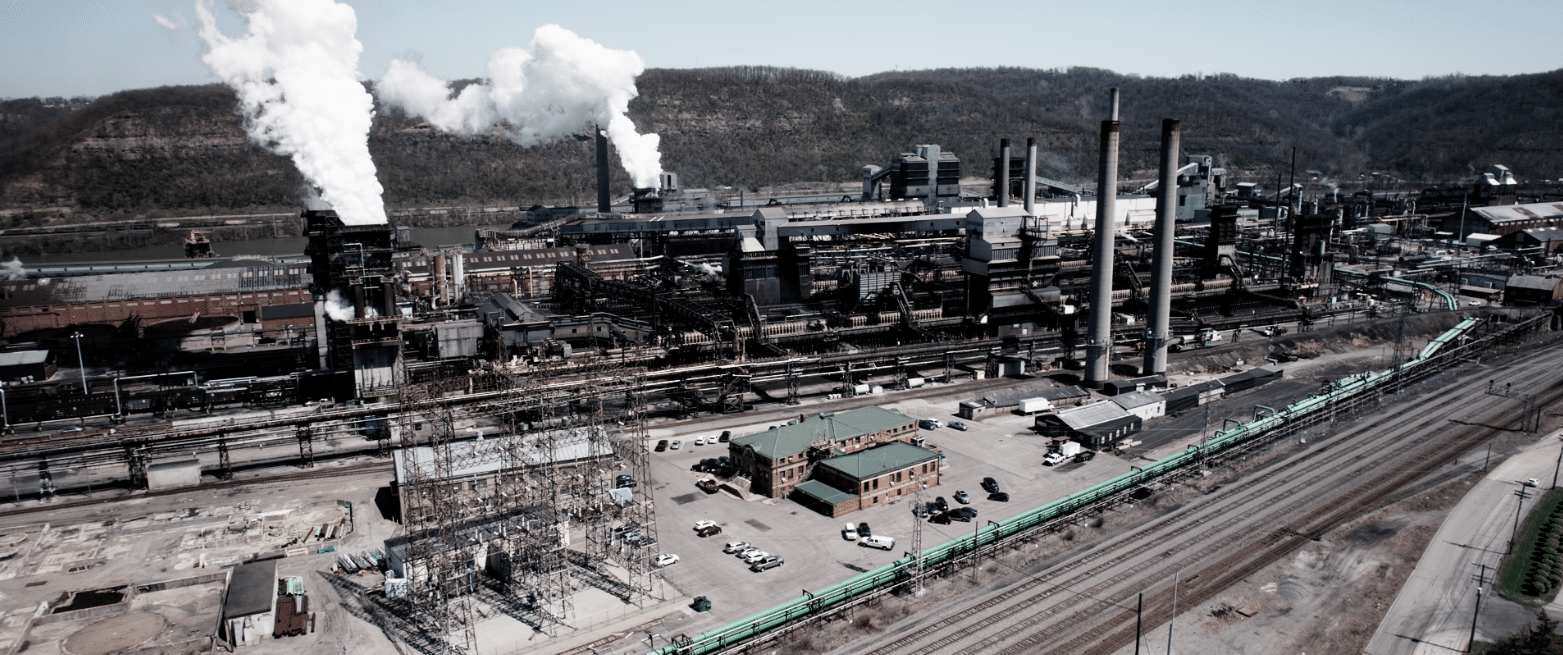
A Lifetime of Air Pollution in Clairton
Art Thomas has lived in Clairton, Pennsylvania for more than 80 years, giving him a firsthand view of how the region’s air pollution problem has shaped life in the Mon Valley.
Thomas remembers moving to Clairton as a young child, when pollution from the mill was so thick that drivers had to turn on their windshield wipers just to clear it off their windshields and see the road.
Decades later, he says, “The smell is still there,” describing the familiar sulfur dioxide odor that continues to drift through the community.
For Thomas, the pollution isn’t an abstract concern but a decades-long pattern with visible consequences. He remembers when Clairton had fruit trees; today, they’re gone. The rivers, once fished freely, are now contaminated with industrial byproducts settled into the sediment.
“It’s been going up in the Mon Valley for over a hundred years,” Thomas says, “and it’s still coming down.”
That simple observation captures what many longtime residents describe: pollution doesn’t disappear. It eventually settles into the neighborhoods where people live, work, and raise their families.
Neighbors Helping Neighbors
Rather than simply accepting those conditions, Thomas has become part of the solution.
He is a member of Valley Clean Air Now (VCAN), a local nonprofit organization working to improve public health and environmental awareness throughout the Mon Valley.
Working alongside community partners, VCAN has helped distribute more than 1,600 air purifiers to residents while educating families about air quality through neighborhood air monitoring efforts. Their work helps residents better understand pollution that often cannot be seen but can still affect daily life.
Why It Matters
Despite decades of frustration, Thomas believes Clairton’s future doesn’t have to mirror its past.
He believes investments in cleaner steelmaking technology could reduce pollution while preserving the jobs and economic stability that have long defined the region.
Thomas says that if the mill invested in cleaner production methods, Clairton could be beautiful again. Until then, he says, residents like him are left living with the consequences of pollution that, as he puts it, always comes down somewhere.


Join the Conversation